Save up to 20% today!

Write a short text about your service
Write a short text about your service





Prayagraj (Allahabad), Uttar Pradesh, India:
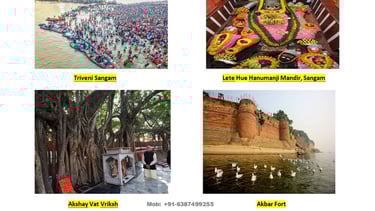
🌊 1. Triveni Sangam
Triveni Sangam is the holy confluence of three rivers:
Ganga, Yamuna,Saraswati (mythical)
It is one of the most sacred places for Hindus. Pilgrims take holy dips here, especially during Kumbh Mela, believing it washes away sins. It’s also a major site for rituals, Pind Daan, and spiritual gatherings.
🕉️ 2. Lete Hue Hanumanji Mandir, Sangam
This temple is famous for the unique lying-down idol of Lord Hanuman.
Key features:
The deity is shown in a reclining posture.
Located near the Sangam area.
During monsoon, the idol sometimes gets partially submerged due to rising river water — considered auspicious by devotees.
It is one of the most visited temples in Prayagraj.
🌳 3. Akshay Vat Vriksh
Akshay Vat means “the indestructible banyan tree.”
According to mythology:
Lord Rama visited this tree.
It was believed to survive even during the great flood (Pralay).
It represents immortality and eternal life.
The tree is located within the Allahabad Fort, and for centuries devotees came to see it as a sacred pilgrimage spot.
🏰 4. Akbar Fort (Allahabad Fort)
Built by Mughal Emperor Akbar in 1583, this fort stands near the Sangam.
Highlights:
One of the most impressive Mughal forts.
Contains historical structures like the Patalpuri Temple and Akshay Vat inside.
Offers a spectacular view of the river.
Known for its massive walls and architectural beauty.
Although much of it is under army control, parts are accessible to visitor
Important and culturally rich locations in Prayagraj (Allahabad), Uttar Pradesh:
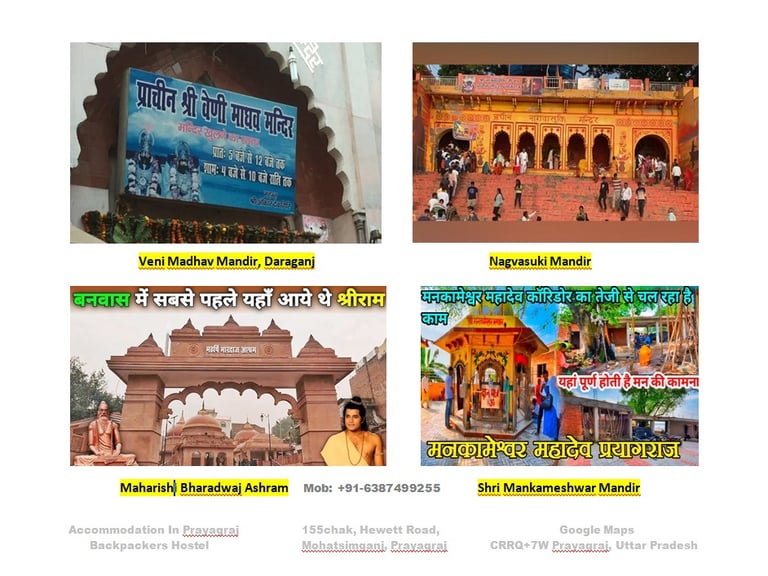
5. Veni Madhav Mandir, Daraganj
This is one of the ancient and culturally significant temples of Prayagraj, located in Daraganj, a traditional locality near the Ganga.
Highlights:
Dedicated to Lord Vishnu, worshipped here as Veni Madhav.
Historically, Prayagraj once had 12 Madhav temples, and this is one of the surviving ones.
The temple is associated with several Hindu rituals performed on the banks of the Ganga.
It is an important stop for pilgrims visiting the Sangam area.
6. Nagvasuki Mandir
This temple is located in Daraganj, on the banks of the Ganga.
Highlights:
Dedicated to Nagvasuki, the king of serpents in Hindu mythology.
According to legends, Prayagraj was once the abode of Nagvasuki.
Devotees visit here especially during Nag Panchami.
The temple architecture shows traditional Indian designs with a large front courtyard that attracts many pilgrims.
7. Maharishi Bharadwaj Ashram
A historically important site linked with the Ramayana.
Mythological Importance:
According to Ramayana, when Lord Rama, Sita, and Lakshman began their exile (vanvas), they first visited Maharishi Bharadwaj's Ashram in Prayagraj.
The sage guided them to go toward Chitrakoot for their stay.
Highlights:
The entrance arch is large and beautifully designed.
The area is peaceful and spiritually significant.
A popular stop for people exploring the Ramayana heritage in Prayagraj.
8. Shri Mankameshwar Mandir
One of the very popular Shiva temples in Prayagraj.
Highlights:
Dedicated to Lord Shiva.
“Mankameshwar” means "the fulfiller of wishes" — devotees believe that prayers here bring desired results.
Undergoing renovation and corridor development in recent years.
Attracts huge crowds during Mondays of Sawan, Mahashivratri, and other Shiva festivals.
Located near the Yamuna river and close to Saraswati GhaIf you'd like, I can also make:
Arail, Prayagraj (on the other side of the Yamuna near Sangam).
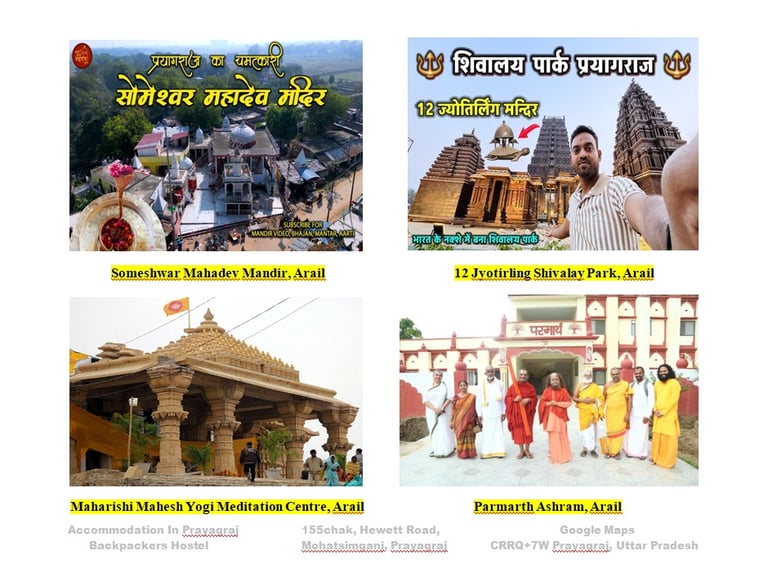
🌄 9. Someshwar Mahadev Mandir, Arail very ancient and revered Shiva temple.
⭐ Highlights:
Dedicated to Lord Shiva as Someshwar Mahadev.
Considered one of the oldest temples in the Arail region.
Situated on a hill-like elevation, giving it a peaceful and scenic environment.
Devotees visit especially during Sawan, Mahashivratri, and Mondays.
Believed to be a powerful place for fulfilling wishes and gaining spiritual strength.
🕉️ 10. 12 Jyotirling Shivalay Park, Arail
A newer spiritual attraction designed to represent the 12 Jyotirlingas of India.
⭐ Highlights:
Miniature replicas of all 12 Jyotirling shrines (e.g., Somnath, Kashi Vishwanath, Mahakaleshwar, Kedarnath, etc.).
Good place for people who want to see all Jyotirlingas symbolically in one place.
Peaceful, family-friendly environment.
Ideal for devotional tours, school trips, and photography.
🧘 11. Maharishi Mahesh Yogi Meditation Centre, Arail
A meditation and spiritual center inspired by Maharishi Mahesh Yogi, the founder of Transcendental Meditation (TM) and known for teaching many world-famous students.
⭐ Highlights:
Calm and serene environment perfect for meditation.
Conducts sessions on yoga, spirituality, and mental well-being.
Popular among seekers of inner peace and yogic lifestyle.
Beautiful temple-style architecture with carved pillars and peaceful surroundings.
🙏 12. Parmarth Ashram, Arail
A spiritual and community-focused ashram known for service and devotion.
⭐ Highlights:
A place for discourses, bhajans, yoga, and spiritual gatherings.
Often visited by saints, spiritual teachers, and devotees.
Known for social work, community activities, and Ganga clean-up programs.
Peaceful environment ideal for those looking for spiritual rest and guidance.
If you want, I can also prepare:
✅ A single combined Prayagraj pilgrimage guide
✅ A 1-day or 2-day itinerary covering all places from all three images
✅ A map-based route plan for easier travel
Just tell me!
The image highlights four significant religious and historical sites in the Uttar Pradesh regions of Prayagraj, Bhadohi, and Mirzapur, many of which are part of ongoing tourism development projects like the Vindhyachal and Prayagraj corridors.
Sujavan Mahadev Mandir, Prayagraj
This ancient temple is situated on the banks (previously in the middle) of the Yamuna River, near Ghoorpur.
Mythology: It is a revered spot where, according to legend, the deity Yamaraj met his sister Yamuna and granted a boon that those who bathe there on the day of Bhai Dooj (Yama Dwitiya) will be free from the fear of death.
History: The site has archaeological significance, with remnants of an ancient urban civilization found during excavations. The original temple was reportedly demolished and rebuilt several times throughout history.
Sitamarhi Samahit Sthal, Bhadohi
Located between Prayagraj and Varanasi on the banks of the Ganges, this site holds immense importance in the Hindu epic Ramayana.
Mythology: This is the sacred spot where Goddess Sita is believed to have re-entered the earth (merged with Mother Earth) after the Agnipariksha (fire ordeal). It is also near Maharishi Valmiki's ashram, where her twin sons, Luv and Kush, were born and raised.
Features: The complex houses temples for Mata Sita and Lord Shiva, along with a 108-foot-high statue of Lord Hanuman.
Shringverpur Dham, Prayagraj
This historical village is located about 45 km from Prayagraj on the banks of the Ganges River and is mentioned in the Ramayana as the capital of the Nishadraj (King of Fishermen).
Mythology: Lord Rama, Sita, and Lakshmana stayed here for a night during their exile, and the Nishadraj helped them cross the Ganges.
Development: The area has been developed into a significant tourist park, featuring a large statue of Lord Rama embracing Nishadraj, symbolizing friendship and social harmony.
Maa Vindhyachal Dham, Mirzapur
Vindhyachal is a major pilgrimage center and one of the most important Shaktipeeths in India, located in the Mirzapur district on the banks of the Ganges River.
Mythology: It is dedicated to Goddess Vindhyavasini, who is considered an eternal resident of the Vindhya mountains. The pilgrimage is often considered complete only after visiting the three main temples forming a Trikon (triangle): Maa Vindhyavasini, Mahakali on Kali Khoh hill, and Ashtabhuji Devi on Ashtabhuja hill.
Development: A major corridor project has recently been completed to ease access and enhance facilities for the high volume of pilgrims, especially during the Navratri festivals.
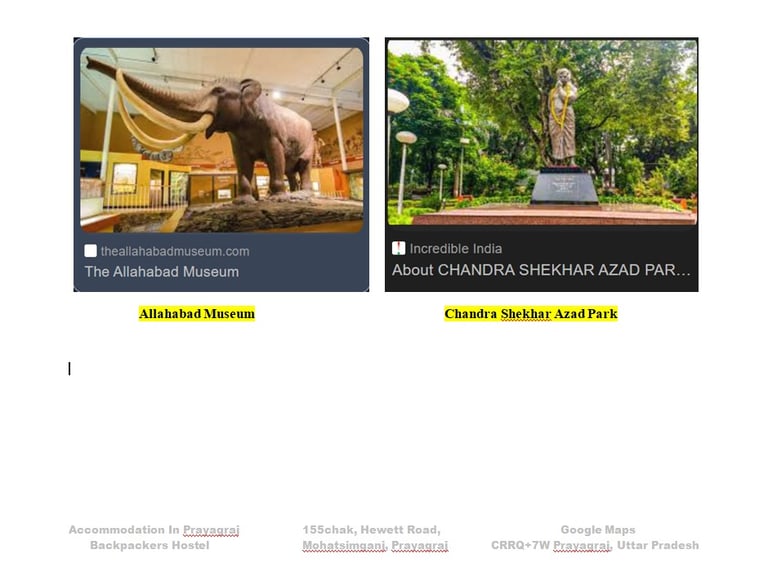

The Allahabad Museum
The Allahabad Museum is a significant national-level museum known for its extensive collection of artifacts related to Indian history, art, and the freedom struggle.
Collections: Key exhibits include archaeological finds, stone and terracotta sculptures (some dating back to 3rd century BCE), miniature paintings, and natural history models.
Freedom Struggle Focus: The museum has dedicated galleries to Mahatma Gandhi and Jawaharlal Nehru, displaying rare letters, manuscripts, and photographs. A highlight is the preserved Colt pistol that revolutionary freedom fighter Chandrashekhar Azad used in his final moments.
Visiting Information: The museum is open Tuesday to Sunday from 10:00 AM to 5:30 PM and is closed on Mondays.
Chandrashekhar Azad Park
This large public park, also widely known by its original name Alfred Park or "Company Bagh," is a blend of natural beauty and historical significance.
History: The park was established in 1870 to mark the visit of Prince Alfred, Duke of Edinburgh. Its most famous historical event occurred on February 27, 1931, when freedom fighter Chandrashekhar Azad was surrounded by British police and died fighting rather than being captured, an event commemorated by a statue at the site.
Features: Beyond its historical memorial, the park offers lush green spaces, jogging tracks, and several colonial-era structures, including the Allahabad Public Library and a large Victorian canopy. The Allahabad Museum is located within its grounds.
Visiting Information: The park is generally open daily from early morning (e.g., 5:00 AM) to late evening (e.g., 9:00 PM), and typically charges a nominal entry fee.
Would you like to know more about the specific historical artifacts on display at the museum, such as the pistol?